


Syllabus: GS2/ Governance; GS3/ Economy
Context
- Recently, the Union Ministry of Petroleum and Natural Gas (MoPNG) invoked the Essential Commodities Act, 1955 by notifying the Natural Gas (Supply Regulation) Order, 2026 amid the ongoing conflict in West Asia and disruptions in LNG shipments through the Strait of Hormuz.
Key Points in Natural Gas (Supply Regulation) Order, 2026
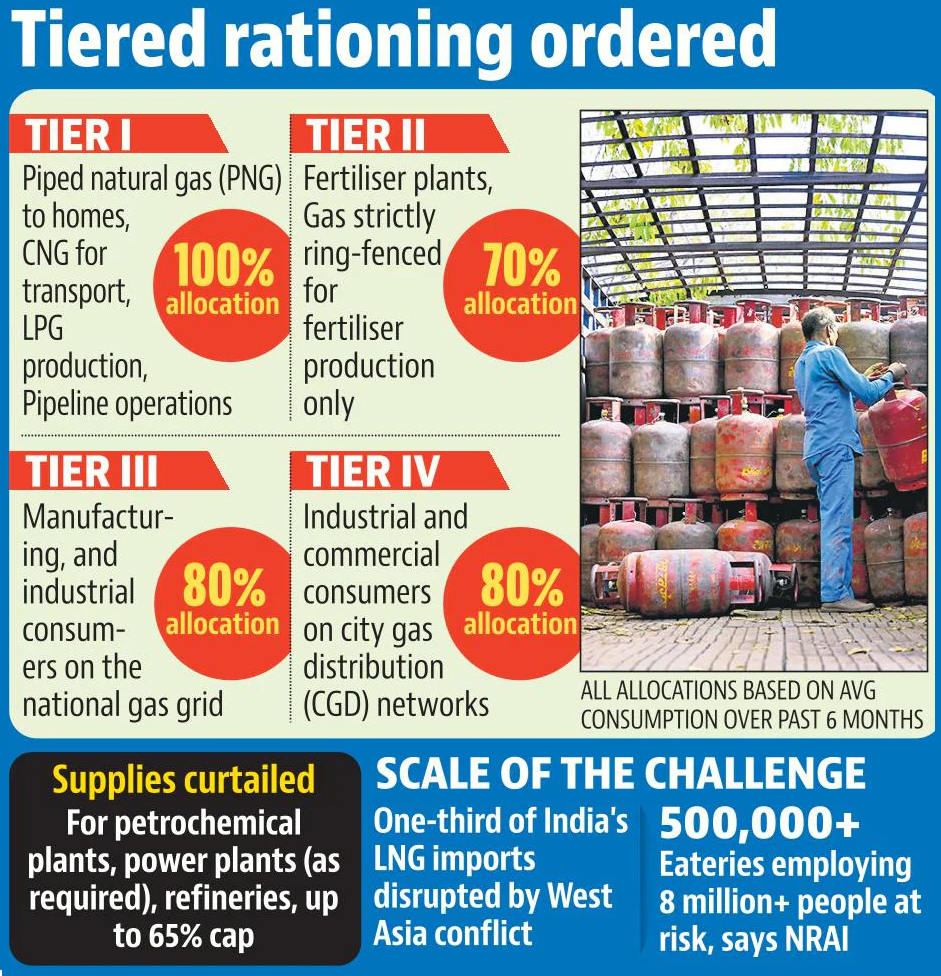
- Establishment of a four-tier priority system for gas allocation: Based on the average consumption of gas from the past six-month.
- Gas redistribution: Lower-priority users like petrochemicals & power plants face cuts to support higher ones.
- Pooled Mechanism: Petroleum Planning & Analysis Cell (PPAC) notifies pooled prices for gas diverted from non-priority to priority sectors, ensuring standardized pricing during shortages.
- Priority sector entities must accept these pooled prices and waive litigation rights over force majeure or supply adjustments.
Reasons for Gas Rationing
- Disruption of LNG Imports: The Strait of Hormuz is a crucial global energy transit route connecting the Persian Gulf to international markets. Conflict in the region has disrupted LNG shipments.
- Around one-third of India’s LNG imports have been affected.
- India’s Dependence on Imported Natural Gas: India’s natural gas demand continues to rise while domestic production remains limited.
- Key Statistics:
- Total gas consumption (2024–25): 71.3 billion cubic metres (BCM);
- Import dependency: about 50%;
- Major LNG suppliers: Qatar, United States, Russia, Australia;
- High import dependence exposes economies to geopolitical shocks and price volatility.
About Essential Commodities Act (ECA), 1955
- It aims to regulate the production, supply, distribution, and pricing of essential commodities to ensure their availability at fair prices and prevent hoarding, black-marketing, and profiteering during shortages or emergencies.
- It empowers the Central Government(and in some cases state governments)to intervene in markets when necessary to protect consumer interests and maintain food and energy security.
Commodities Covered Under the Act
- The central government can declare certain goods as ‘essential commodities’.
- Common examples include food grains (rice, wheat, pulses); edible oils, sugar, petroleum and petroleum products, fertilisers, drugs, LPG and natural gas.
- The government can add or remove commodities from the list depending on national requirements.
Key Changes in 2020 (During Covid-19)
- The Essential Commodities (Amendment) Act, 2020 introduced major reforms to liberalise agricultural markets.
- It aims to encourage private investment in storage, cold chains, and supply infrastructure.
- Removal of Several Agricultural Commodities from the List: Certain items were deregulated except in extraordinary circumstances.
- It includes cereals, pulses, oilseeds, edible oils, onions, and potatoes.
- Stock Limits Only in Extraordinary Situations: The government can impose stock limits only under exceptional conditions, such as war, famine, extraordinary price rise, and natural calamities.
- Price Trigger for Stock Limits: Stock limits can be imposed only if prices increase significantly:
- 100% increase in price of horticultural produce;
- 50% increase in price of non-perishable food items;
- Exemption for Value Chain Participants: Stock limits do not apply to processors or exporters if stocks are within their production or export requirements.
Previous article
News In Short 10-03-2026
